How real? How relevant?
In
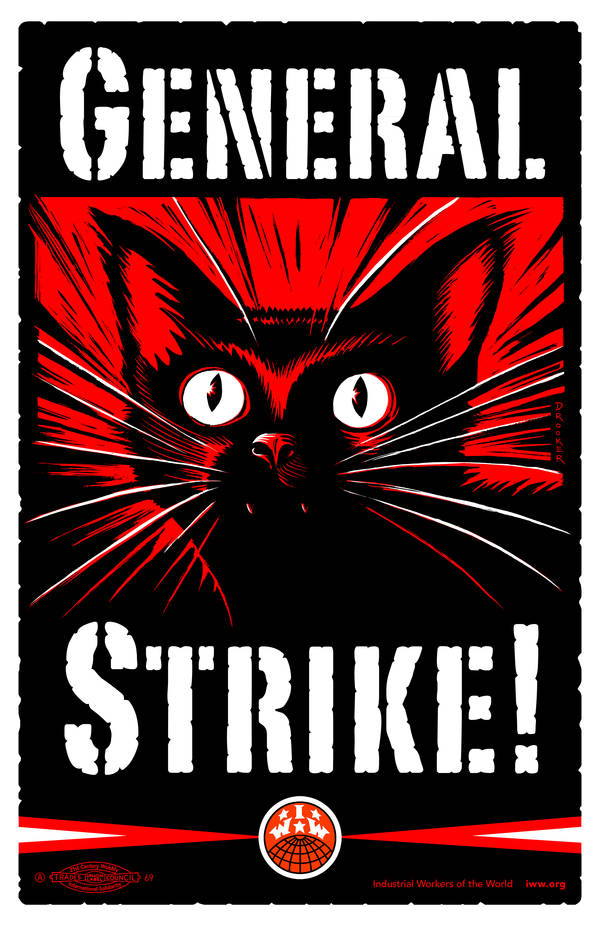
at least four countries, there will be a general strike on November 14. There
are calls to turn it into a European general strike. What to make of the idea,
how to operate most fruitfully in connection to these and similar initiatives,
is the subject of this article.
November 14 will – at the very least – see strike action against austerity
in four European countries: Spain, Portugal, Greece and Cyprus. (1) There is
the potential of much, much more, and people from very diverse backgrounds are
working in the direction of en Europe-wide general strike on that day. Does it
make sense? How can we contribute in such ways that N14 – as the date is
beginning to be called – can become much more than yet another mostly symbolic
action such as we have been seeing many times already?
First, the situation itself. Trade union federations have called nationwide
one day general strikes for November 14 in the four countries I mentioned.
Apparently, union federations in France and Italy are considering the idea as
well. Let's be clear on the importance of this. Union federations do not launch
these kind of strikes because they want serious resistance to austerity.
Rather, they want these strikes as a show of force to strengthen their own
positiaon as mediators of the class struggle, as managers of discontent. They
want to show governments and bosses: hey, there is a lot of discontent amongst
workers. We will try to hold it in check for you; it is our (rather well-paid)
job. But you have to give some concessions, you have to soften your stance on
austeriry a bit. Only that will enable us to play our role, ony then we can say
to our members: trust us, don't rock the boat, we will bring about some
improvements. To show governments that the trade union leaders have to be taken
into account, trade union leaders call their members to strike, as if to say to
govermnent: do you see all these angry workers? Do you feel the disruption they
cause, for just one day? Now, do you appreciate our trouble to keep them quiet?
Please help us doing so, by giving us concessions to increase our credibility
among these workers. Or would you rather have these workers pushing us aside
and fighting on their own terms? Would you rather have strtikes without fixed
duration, wildcat strikes, all-out class confrontation?
These strikes, then, are entirely bureaucratic in their motivation, as far
as trade union functionaries are concerned. Workers, however, tend to see them
as opportunities to show their anger, and make their anger felt. Rightly so!
For radicals, that makes them relevant. The more a strike call is supported, in
as militant a fashion as possible, the stronger workers will feel, the stronger
ties of solidarity will be built.. In itself, this does not stop governments or
austerity policies. But it builds working class strength and confidence needed
for a serious struggle. Trade union leaders use these kind of strikes to parade
workers as their stage army. Radical workers, anarchists among them, want to
see the soldiers of that army starting to fight on their own account, turning
the stage army in an independent force fighting from below. That is whay
libertarian communists should, in my view, take these strike calls seriously.
Not because we trust the trade unions, but on the contrary, because we doe not
trust them, and refuse to leave the struggle in their iron grip.
The general strikes on N14 will not, in themselves, stop austerity or bring
down governments. Even a one day European strike will not do that. Greece has
seen 20 general strikes of this type. Yet, the government did neither fall nor
budge because of that. One can say that, without the discontente expressed through
thesee strikes, the Greek goverment and the EU bureaucrats would feel even more
arrogantly confident to push on; in that sense, the strikes may have acted as a
brake. But it is clear that to beat back austerity, a much more offensive
approach – ongoing strikes, occupations, street blockades, confrontation with
the state – will be needed (2). But the mobilizations around the strikes can be
used as stepping stones in that direction. The same applies to the European
wide strike action now being organized and discussed for N14. And yes, when you
are striking in Spain in the knowledge that workers in Greece, Portugal and
Cyprus (and Italy? And France? And... ?) are out on strike, it probably raises
your confidence, making you feel part of an even bigger whole. So yes, by all
means, let's support the European-wide general strike – in our own independent
fashion. It is not at all the magic trick to end our problems. But we can use
it as part of building our fight – and spreading our ideas within the fight.
How? I have not very much to say here about the specifics of struggle in
Spain, Portugal, Cyprus and Greece. The general idea is clear: making the
strike as forceful as possible, challenging the top-down union bureaucratic
grip on events, connecting with ongoing struggles, introducing direct-action
dynamics within and around the strike and connected demonstrations. For
instance, the anti-austerity protest organized in Londen last Saturday was by
trade unions along familiar, bureaucratic, blowing-off-steam-and-then-go-home
lines. However, as mentioned in “What October 20 tells us about the state of
the movement”, on Libcom (3), Disabled People Against Cuts held a beautiful
street blockade with wheelchairs as part of the action which raised the
temperture and added to the pressure. Initiatives like these can make
mobilizations much more forceful than trade union organizers intend them to be.
Radicals in the countries where the strike is on will find their way.
There are, however countries where ther is no general strike call from trade
union circles in sight. The Netherlands is one of these countries. Yes, ETUC,
the European trade union federation, has made a call for
“a day of action
and solidarity on 14 November, including strikes, demonstrations, rallies and
other actions.” (4) Not quite a call for a general strike, but a step in
that direction. The purpose:
“mobilising the European trade union movement
behind ETUV policies as set down in the Social Compact for Europe”.
Whatever is in that document, people will understand this call as a protest
against the European-wide austerity policies, at least in their current form.
Just like national general strike calls can be used to mobilize around in the
direction of a more radical approach, the ETUC call can be used to build in the
direction of European-wide strike action and more. This is what people, myself
included, are trying to do in the Netherlands.
It is important to do it right, however. There is the temptation to get
stuck on trade union territory, to just take the ETUC call, step to the unions
and demand that they organize strike action, imploring them, pressurizing them,
leaving it up to them. This is the approach that Trotskyists use in Britain:
demanding that the TUC organize a general strike. Lenin's Tomb expresses the
idea:
“there is a basis for mass industrial action to happen if only the
trade unions are willing to support it.” (5) Ah, if only! They will solve
the problem for us! And what if they don't? Wait for better days and Sell the
Paper? I think a much more fruitful approach can and should be tried. The idea
of e a general strike on a European scale can be pushed by radical circles,
whether anarchists, Occupy-related networks, other formal or informal netwerks
of radicals.
For the day itself, street actions can be planned, noisy pots-and-pans
protest marches ans assemblies like in Quebec last summer, blockades of
buildings where hated, austerity-related institutions are seated, 'ordinary'
demonstrations, pickets at embassies of states where general strikes are going
forward. People might spontaneously get sick of austerity on that 14th of
November as well. Anything to express solidarity with the struggle against
austerity. Anyything to raise the anti-austerity temperature. And all
exoplicitly connected to the general strike idea for N14. And who knows, there
might just be an office department, a factory, a company, where workers are
already so fed up and confident that they might come out on strike. There might
even be a trade union branch or wing here and there that is sensitive to the
mood, and starts supporting the idea. You never know how far you come unless
you try. However, our approach should not make itself depend on that unions
will or will not do. Independent initiative and organization from the bottom
up, are essential. Waiting for the unions would be catastrophic and, more
importantly, it is entirely unneccessary.
The idea has been tried before. On May Day this year, calls went out in the
US for a general strike. Occupy- and related initiatives spread the call, and
organized street protests on that day. No, it was not a general strike. But is
spread the idea of such a strike, and it was a step in that direction. No, a
combination of the actions that I mentioned for N14 will very likely not amount
to a full general strike, it may not even come close. But it
would
spread the idea that strike action is needed and should be built, it would be a
step in the right direction. And maybe it could become a dress rehearsal for
something much bigger as well, on the First May 2013...
[1]
“Anti-Austerity
Allies Coming Together for Cordinated European Strikes”, Common Dreams, 19
oktober 2012,
[2] The insights that Thrasybulus expresses in
“General strike:
Round 20”, on Libcom.org, are vital here.
[3] Phil,
“What
October 20 tells us about the state of the movement”, Libcom.org, 21
October.
[4] ETUC,
“ETUC day of action and
solidarity for a Social Compact for Europe” , October 17
[5]
“Mass
protests against the cuts”, Lenin's tomb, October 20.
For this article, the forum thread on Libcom,
“European
general strike? 14 November” , has been very useful.


 “Sarà una giornata d’azione e di solidarietà, perché secondo le diverse condizioni i sindacati d’Europa decideranno caso per caso la forma di mobilitazione più adeguata”. Bernadette Ségol, segretaria generale della Ces (la confederazione europea dei sindacati), descrive con queste parole la Giornata europea di protesta che si svolgerà in quasi tutti i paesi dell’Unione il prossimo 14 novembre.